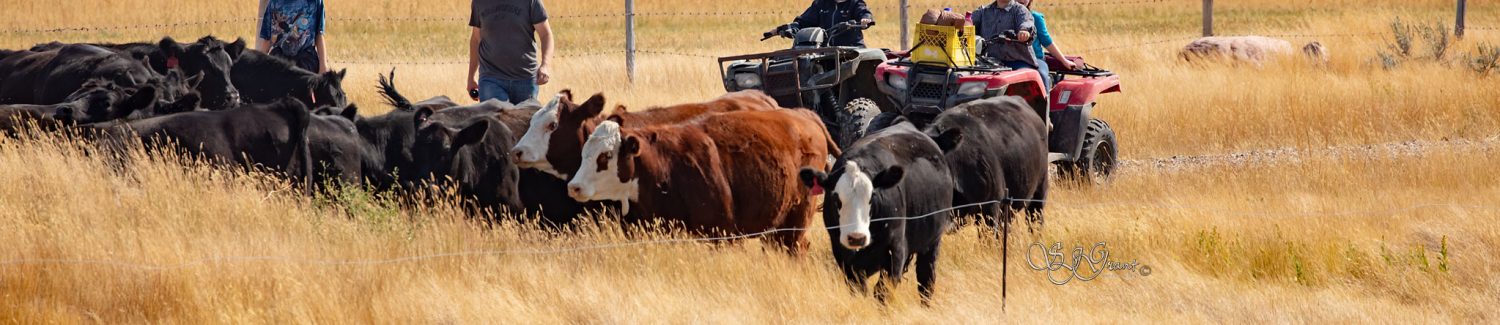
Halfway into May and we have many more calves on the ground. There have been a few hiccups throughout this calving season but for the most part it’s as smooth sailing as it comes. Of course the hiccups are the moments you think of first but the times of things not going to plan allow for us to learn how to adapt and overcome the challenges to make things better and prepare for next time.
The lone calf
When we check cattle we pay attention to anything that’s out on its own. Cattle are social creatures, they enjoy being around one another so when they’re off on their own there tends to be something going on. When a calf is out on its own its mom either left to go eat or get a drink and will be coming back later or it’s an orphan. So when we happen upon a calf that looks like it hasn’t gotten much to eat and is on its own we tag it with the date we found it and for the next few days whenever we come back we check to see if it’s paired up. If we go a few days without seeing it next to a cow we officially label it as an orphan and bring it to the yard. We wait those few days because we don’t want to make an orphan if the calf isn’t one.
We came across one of these suspected orphans earlier in the week and tagged it. A few days later as it was still on its own we made the assumption that it hadn’t got to suck in a while so two of us went out to find, catch, and feed him. It took a bit of chasing to catch him and once he was wrestled down one of us went back to the truck to get water and milk replacer. In my wait I happened to shift the way I was sitting on our suspected orphan and as soon as he felt that little bit of freedom, he jumped on it and jumped up when I wasn’t expecting it. Fortunately he didn’t go too far with his escapade and I caught him quickly, it was then decided that it would be easier to just tie him to the quad so he wouldn’t be able to get far.
By the time milk arrived the fight for him wasn’t to keep him still, it was for him to drink some. You can only fight with a calf to drink for so long before you admit he’s not hungry or that he’s wanting to die, and with how much I was being fought he more than likely had enough energy to say he had sucked earlier in the day.
We continued to keep an eye out on the little guy for a couple more days and when he was discovered paired up and drinking from a cow, there was a sigh of relief knowing that there wouldn’t be a new bottle baby.

Flatter than a board
When we do find a calf who looks like they haven’t sucked in a while we’ll give them a bottle of colostrum and then go out and look for a mom. Colostrum is the first form of milk produced by a cow (any mammal actually) after childbirth, it provides ideal nutrition so it is extremely important for a newborn calf. If we do find a mom we decide if the cow isn’t letting the calf suck or if it won’t suck and go from there.
A couple days ago during a check, a pancake-like calf was found, fortunately with her mama sniffing around her. The calf had absolutely zero energy, laying there as if it were dead, so we couldn’t tell whether it was a matter of not sucking or not being allowed to suck. We found quickly what the answer was when the calf wouldn’t suck on any of our fingers nor the bottle of colostrum we had made for it. With how lifeless the calf looked the plan was to take the pair to the yard and get some milk in the calf, so that’s exactly what we did. The nearest place that we could load the cow was half a mile east, so as the cow began getting trailed I dealt with picking up the ragdoll of a calf and putting her in the trailer. The cow trailed quite nicely and loading her went down without a hitch, unloading the calf and getting it fed was the only difficult part when we got back to the yard. She still wasn’t sucking at this point and the only way we could get any milk into her would be by tube feeding. Tube feeding is when a feeding tube is inserted down the esophagus and to the stomach, it is done very carefully and slowly to prevent injury. Tube feeding means that the colostrum will get down into her stomach without her having to swallow, which was our only option at that point.
The past couple of days bottle feeding it there has been a bit of progress as she’s trying to suck now and has been put on a bottle instead of a feeding tube. She also stands for a while now which is much better than her laying and not moving. Life is beginning to seep back into her, especially as we’ve watched her try and suck from her mom as well. Our fingers are crossed for more progress with her.

The issues we face during calving season are everyday occurrences for ranchers all over the world. It’s not about how few problems you have that make you a good rancher, it’s how you go about fixing them that matters.